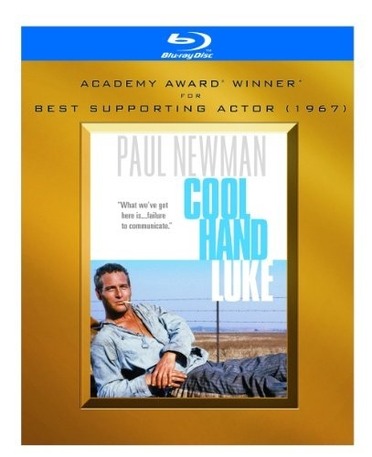


There are stars and then there are actors like Paul Newman, whose iconic presence and piercing blue eyes regularly transcend even the best material in which he works. The cocky gait of Cool Hand Luke may wobble from time to time, but Newman’s magnetic personality lends the film the weight its relatively simple story struggles nobly to support. Shot in stunning widescreen by Conrad Hall (all the better to capture the glint of the high noon sun and the glistening, shirtless prisoners of a chain gang), Stuart Rosenberg’s film ambitiously vacillates from a straightforward antiauthoritarian story to a macho tall tale and winds up ultimately as a somewhat curious and incomplete Christ allegory.
That it falls awkwardly somewhere in between should surprise no one, but Cool Hand Luke remains thoroughly engaging all the same. Newman plays an enigmatically recalcitrant everyday guy, lucas “Cool Hand” Jackson, thrown into prison for rebelliously cutting the tops off parking meters. Once incarcerated, he unsurprisingly butts against an even more stubborn system of rules, and as his trouble-making stoicism grows more disruptive, the punishments doled out to him grow more severe. Filled with quotable lines and memorable scenes, Cool Hand Luke exists as an iconic work in and of itself, deceptively light in meaning but definitely full of cultural (and countercultural) significance.
Indeed, several lines from the film have entered the cinema lexicon (the menacing understatement “What we have here is failure to communicate:’ for one), whereas scenes like the egg-eating bet and a prison yard fist fight are the stuff of movie legend. A great deal of Cool Hand Luke’s considerable charm stems from its colorful cast of supporting actors, a contingent of notable faces that include a young Dennis Hopper, Harry Dean Stanton, and George Kennedy as Newman’s rival turned right-hand man.
Kennedy took home the Academy Award for Best Supporting Actor for his portrayal of the ultimately na”ive tough guy Dragline. But at the heart of the film is Newman’s quietly charismatic performance, which showcased the actor at the top of his game and propelled him toward the peak of his popularity. Compared to Jack Nicholson’s scenery-chewing performance in the oddly similar One Flew Over the Cuckoo’s Nest, Newman in Cool Hand Luke is all subtle, knowing smiles and beaming confidence. Short on soliloquies, Newman’s luke doesn’t telegraph his every move or even clarify his motives. He seems almost to have sought out prison as an arbitrary challenge, inviting a conflict with the, system just to see if he can win. In fact, it isn’t until close to the film’s conclusion that the toll imprisonment has taken on the freespirited luke becomes clearer. Unlike the rest of the prisoners, Luke steadfastly rejects the institutional conformity that comes with confinement, and his uncooperative stance ultimately leads to tragedy. If Cool Hand Luke is partly about how far one man can push the system, it’s also about what happens when that same system pushes back. —Joshua Klein (1001)
Paul Newman gives one of the defining performances of his career, and cemented his place as a beautiful-rebel screen icon playing the stubbornly tough and independent title character in "Cool Hand Luke". And before he became familiar as a sidekick in 1970s disaster movies ("Earthquake" and the "Airport" movies), George Kennedy won an Oscar for playing Dragline, the brutal chain-gang boss who tries to beat loner Luke's cool out of him. It's a classic rebel-against-the-repressive-institution story in the line of "One Flew over the Cuckoo's Nest" or "The Shawshank Redemption". Certain moments have become classics—particularly the hardboiled egg-eating contest, and the immortal line (drooled by Strother Martin, as a sadistic redneck prison officer), "What we have here is a failure to communicate." And don't forget, Luke is also the source of the oft-quoted driving ditty, "I don't care if it rains or freezes, long as I have my plastic Jesus, right here on the dashboard of my car..." He is cool, all right. The digital video disc is in anamorphic widescreen and digital stereo. "—Jim Emerson"
| Paul Newman | Luke |
| George Kennedy | Dragline |
| Strother Martin | Captain |
| Lou Antonio | Koko |
| Conrad L. Hall | Cinematography |
| J.D. Cannon | Society Red |
| Robert Drivas | Loudmouth Steve |
| Jo Van Fleet | Arletta |
| Clifton James | Carr |
| Morgan Woodward | Boss Godfrey |
| Luke Askew | Boss Paul |
| Marc Cavell | Rabbitt |
| Richard Davalos | Blind Dick |
| Robert Donner | Boss Shorty |
| Warren Finnerty | Tattoo |
| Dennis Hopper | Babalugats |